
A Better LinkedIn About Section for Independent Consultants
Your About section is not an autobiography with a sales line added at the end. For an independent consultant, it should help a potential client understand the work you do and the experience behind it. Start with their situation. Your career history becomes more useful once the reader knows why it matters to the problem they are trying to solve.
In this guide
Open with a problem the reader recognises
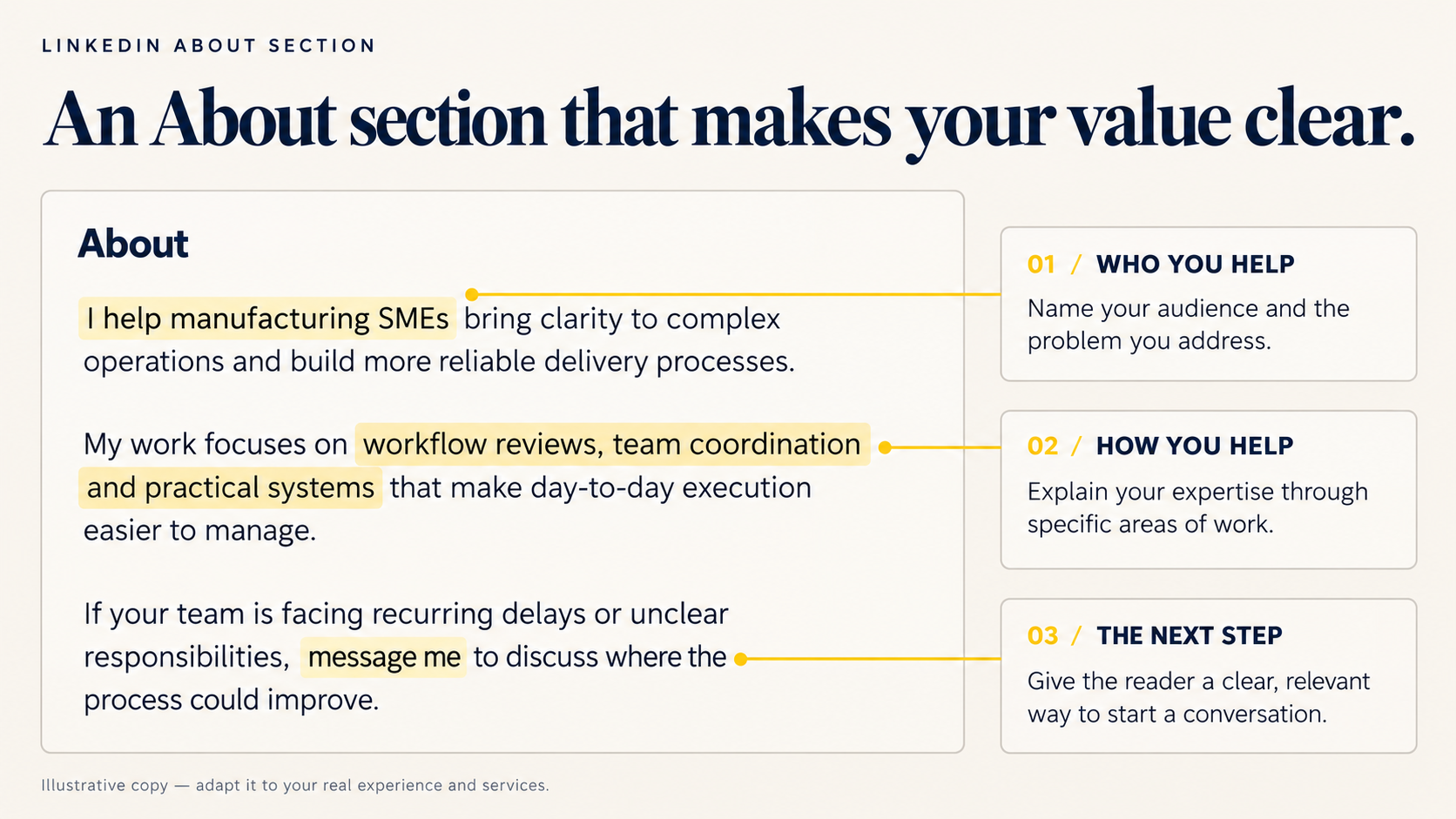
Try a direct sentence about your audience and focus. Illustrative example: “I help growing operations teams bring structure to planning, reporting and delivery.” The wording works only if it describes your actual service. Avoid borrowing a broad transformation promise that leaves the reader unable to explain what you would do during an engagement.
Show what sits behind the offer
Describe the practical work: reviewing a process, clarifying requirements, preparing a plan or supporting implementation. Choose details a prospective buyer would recognise. An IT consultant and an HR adviser need different explanations. Plain language makes the work accessible without removing the specialist knowledge that gives the service its value.
Use your background as supporting evidence
Mention relevant responsibilities, projects or qualifications. Connect them to the service rather than listing every career highlight. If your independent practice is new, describe previous employment experience accurately. If clients cannot be named, use approved context and avoid revealing identifying details. The reader should understand why you are suited to the work without encountering unsupported claims. Keep evidence close to the claim it supports, rather than making readers search.
Build a short example in your own words
An illustrative structure is: “I support B2B service teams that need clearer content planning. My work covers audience definition, content themes and an approval routine the team can maintain. My background includes relevant account and project responsibilities. If your content feels disconnected from your services, let’s discuss the situation.” Replace the details with your own offer and evidence. The structure is useful because each sentence answers a different question.
Close with the conversation you want
Tell a suitable reader when to contact you and what they can discuss. Then read the section aloud. Remove any phrase you would feel uncomfortable saying to a client. Your About section should sound like a capable professional explaining their work clearly. It does not need to sound larger, louder or more established than the practice you actually run.
A reusable About-section framework
- Audience and situation: “I work with [specific teams] when they need to [recognisable task or problem].”
- Scope: “My work covers [the activities you actually deliver], with [important boundaries or client responsibilities].”
- Relevant evidence: “My background includes [accurate roles, responsibilities or approved examples].”
- Approach: “I begin by [a meaningful first step] before recommending [the next part of the engagement].”
- Invitation: “If you are dealing with [relevant situation], let’s discuss the context.”
Example: an IT implementation consultant
Illustrative draft: “I support delivery teams preparing for enterprise-system implementations. My focus is clarifying requirements, responsibilities and handover information before execution becomes harder to coordinate. My background includes implementation and stakeholder responsibilities that I can discuss in more detail. I begin by understanding the current scope and the people involved, then help organise a practical working plan. If your team is preparing an implementation and needs clearer ownership, let’s discuss the situation.”
This is a writing example, not an Elevare Me client story or a claim about a real consultant. Replace the scope and background with facts you can substantiate. Keep only services you are qualified to provide.
How to adapt the framework for another field
An HR consultant could describe the hiring or people-process problem they address; a marketing consultant could explain the positioning or planning work they handle. Do not change only the job title and leave the rest generic. The buyer, scope, evidence and first step should all fit the practice.
Read the draft as a potential client would. Can you explain what an engagement might involve? Does the evidence support the offer? Remove repeated career highlights that do not answer those questions. The structure is a starting point, not a script everyone should publish unchanged.