LinkedIn Profile Audit: Find the Gaps Before Rewriting Everything
A profile can be complete and still leave people confused. An audit helps you find the cause before spending time rewriting sections that were already doing their job. Begin with the opportunity you want the profile to support. Then review the page through that reader’s eyes, looking for unclear messages, missing context and information that no longer reflects your work.
In this guide
Check whether the first impression is accurate
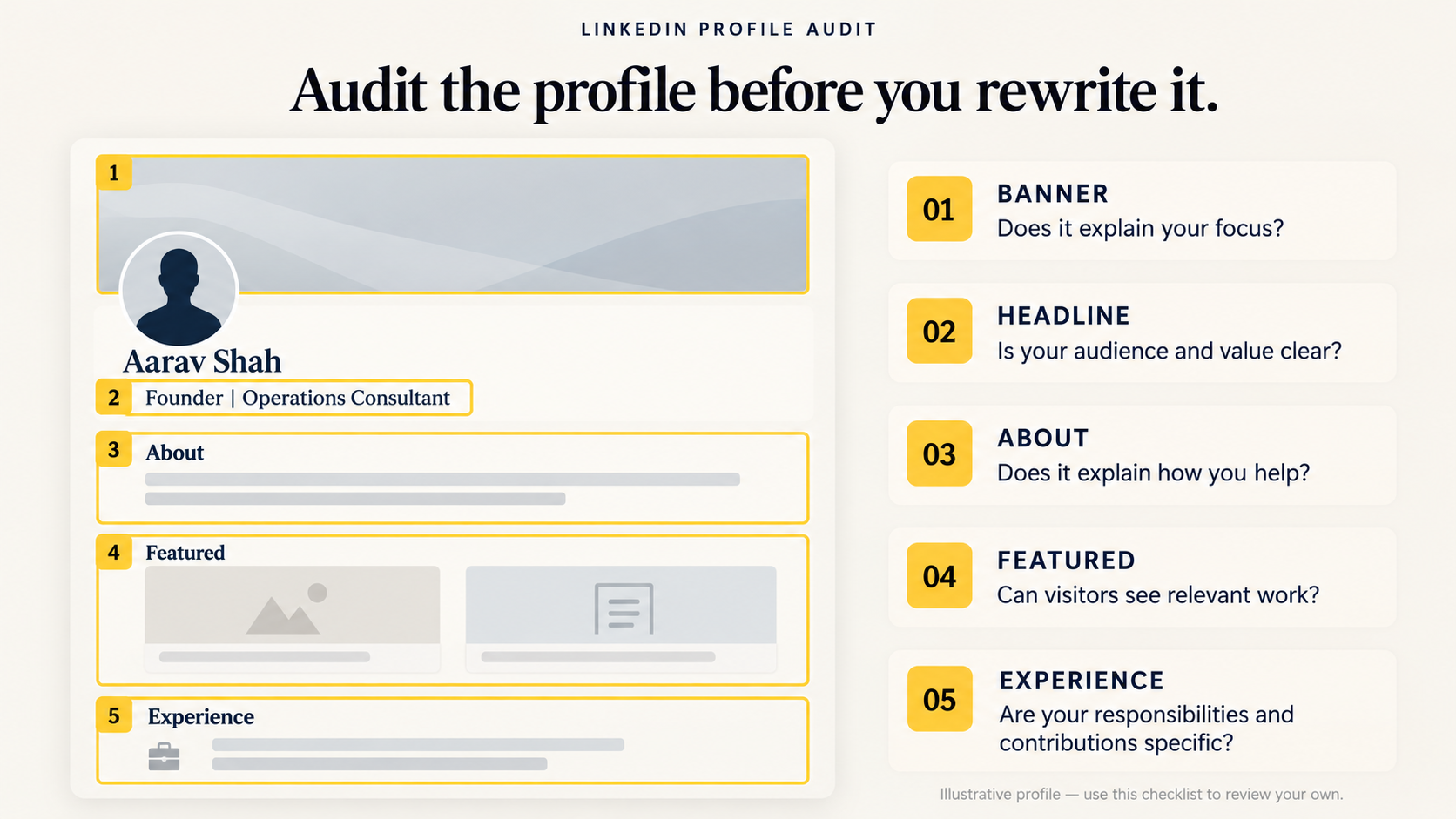
Look at the photograph, banner, headline and current role together. Do they suggest the same professional direction? A career change or new consulting service can leave the top section behind. Read it on a phone and ask whether the important information is easy to understand. Decoration should support the message rather than compete with it.
Find the claim that needs more explanation
Read the About section for substance. Can the visitor understand what you do, where your experience comes from and why it might matter to them? Replace vague strengths with useful context. If a sentence makes a large promise, identify the evidence behind it before making the wording more prominent.
Follow the evidence through the page
Review recent roles, dates, skills, qualifications and suitable work samples. Explain your contribution without inflating your responsibility. Open every Featured link and remove material that is outdated or unsuitable for public sharing. Check the profile against your website and application materials. Different emphasis is fine; conflicting professional facts are not. Keep a record of what you changed and why, so the next review can assess the message rather than begin the entire exercise again.
Check whether the next step is obvious
A recruiter, collaborator and potential client may want different information. Make the relevant contact route and professional direction understandable. You do not need an aggressive call to action in every section. A suitable visitor should simply know what kind of conversation is welcome and how to start it.
Turn the findings into a short priority list
Fix inaccurate information first, then the unclear headline or weak explanation of recent work. Leave minor cosmetic changes until the message is coherent. If copy and visuals are the main gap, consider a profile makeover. If the profile is clear but ongoing activity is inconsistent, content support may be more relevant. A useful audit gives you a reason for each change, rather than a long list of things to alter.
Use a simple audit worksheet
| Section | Question to answer | Evidence to look for |
|---|---|---|
| Headline | Can a new visitor identify your professional focus? | A recognisable role or service, without unrelated labels |
| About opening | Who is this for, and what should they understand? | A direct introduction connected to your current goal |
| Recent experience | What did you personally contribute? | Responsibilities, scope and examples you can explain |
| Featured material | Does each item add useful context? | Working links and public, approved material |
| Next step | Would a suitable person know how to approach you? | An appropriate contact route and clear professional direction |
Turn a weak line into a useful description
Illustrative original: “Responsible for coordination and reporting.” Before rewriting it, ask which teams were involved, what was coordinated, what report was prepared and who used it. If accurate, a stronger version could be: “Maintained weekly delivery updates and tracked open actions between the operations and implementation teams.” The improvement comes from context. It does not require a fabricated performance metric.
Do the same exercise for each important claim in the About section. “Strategic leader” needs an explanation of responsibility; “consultant” needs an explanation of the service. Keep supporting detail where a reader would naturally look for it.
Prioritise the changes in three passes
- Accuracy: correct dates, titles, qualifications, broken links and information that should not be public.
- Clarity: improve the headline, opening introduction and descriptions that leave the reader guessing.
- Presentation: align the banner, photograph, formatting and supporting material with the professional message.
Validate the audit with an unfamiliar reader
Ask what they think you do, what evidence supports that impression and what they would contact you about. Do not explain the profile before the exercise. Compare their answer with the purpose you wrote at the start. If it differs substantially, revisit the message rather than adding more decorative detail.